What Buildings Are Beef Cattle Kept in
Introduction
In New England, beef enterprises are cow/calf, feeder, or a combination of both. Cow/dogie enterprises unremarkably crave less fiscal investment in facilities than feeder operations. Feeder cattle facilities require more solitude pens, more automation of feeding systems and less need for roofed shelters. Each blazon of facility must exist designed appropriately.
Several different designs for housing and treatment facilities are suitable for beef operations taking into consideration the weather, topography, and the availability of feed and pasture. It is important to know all the rules and regulations with respect to location, design, and blazon of operation. Bank check with your local Building Inspector to obtain the required permits prior to building or renovating your existing facility. You lot should also talk to an experienced builder or contractor to ensure the cost of the facility is within the objectives of the operation.
Information technology is important to choose a location for buildings and handling facilities that is on well-drained soil with properly designed surface water drainage situated away from streams, other bodies of water and is not shut to population centers. Check with your county Natural Resources and Conservation Service (NRCS) part for recommended guidelines.
Some Recommended Structures for Beefiness Cattle Housing
Open sided, single gradient roof shed
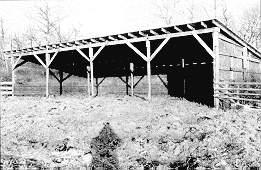
This blazon of housing is most typical of structures used and is suitable for all cattle on the farm. This is the least expensive of new structures and very easy to build. Open up sheds should face the south for wintertime sun and block the prevailing winds. Pole barns of this design can be partitioned for groups of animals without complicated interior structure.
Open up sided, clear span pole shed
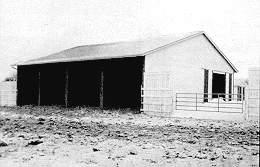
The clear span provides more space for equipment to remove manure and thus whatsoever side of the building can be open to the environment. The gable end of the befouled is recommended to be open then that the belch of rain and snow is not over the open side of the building. When the gable end is open up, the trophy areas are usually deeper and provide more protection from the air current. The back end of the structure may be nighttime and clammy and may demand additional design attention for ventilation and lighting. This type of housing is more applied for smaller sized herds (nether 20 caput of cattle).
Former Dairy Barns
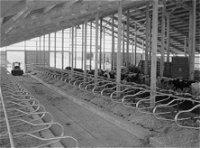
Today there are many unused dairy barns due to dairy farmers either retiring or dispersing. The renovation costs are usually less than the cost of a new structure. Lighting and ventilation are usually adequate in sometime dairy facilities for employ by beef cattle. Manure removal is a major piece of the renovation plan. Conventional tie stalls that are used on New England dairy farms with a gutter are non recommended. Free stall barns are the ideal dairy facility for use with beef cattle since the manure treatment is already set up-up.
Hoop Barns
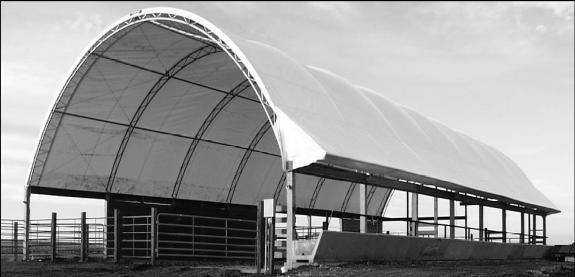
One of the to the lowest degree expensive structures for housing cattle is the hoop barn. Hoop barns are like to greenhouses. Ane disadvantage is the rut and ventilation problems during the summer months, but this should not pose an issue if you lot are planning on grazing your cattle during the warmer climate months.
Feeding Equipment
Feed Bunks
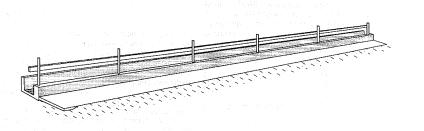
The main requirements for feed bunks are that they are practical, good quality, rugged, and economical. The bunk length and chapters should meet livestock requirements.
Portable Hay Feeders
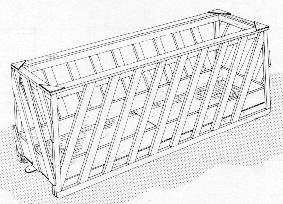
This portable feeder is a proven hay-saving design for free-choice supplementary hay feeding in a field, feedlot, or loose housing barn. The sloping spacers allow cattle of varying sizes to feed comfortably with their heads inside the feeder. This helps to reduce waste since cattle do not have to withdraw their heads to stand and chew.
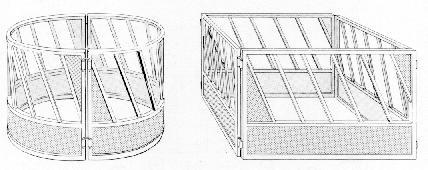
Round and big bale feed racks are easy to load, movement, and also prevent hay wastage. The round version requires a bender to reform the foursquare tube rails, but the circular shape makes information technology easier to whorl it from identify to place. The square version is easier to build in the farm shop, and it tin exist completely complanate for send in a pickup truck. Important feed- saving features are the solid lower department and the slanted divider bars above.
H2o Equipment
Many watering equipment system options are available. Dissimilar systems may be used throughout the twelvemonth. If you are grazing animals, you lot may desire portable water tanks to reduce the impact of cattle in ane location. In the winter, depending upon your climate, yous may demand heated units for utilize in pasture. There are many things to consider when selecting a system for use on your farm. The most important factor to understand your livestock' water needs and ensure that the current organization can meet those requirements.
Headgate
The headgate is the most important part of the entire working facility. It should exist sturdy, safe, easy to operate, and piece of work smoothly and quietly. Headgates come in four basic types; cocky catching, scissors-stanchion, positive-control and fully opening stanchion. The self-catching headgate closes automatically due to the move of the animal. The scissors-stanchion type has biparting halves that pivot at the lesser. The positive-control type locks firmly effectually the animal's neck. The fully opening stanchion consists of two biparting halves that piece of work like a pair of sliding doors. The self-catching, scissor-stanchion and the fully opening stanchion are available with either straight or curved stanchion bars. The straight-bar stanchion is extremely rubber and will rarely choke an brute. The disadvantage is animals tin can movement their heads up and downwardly unless a nose bar is used. The curved-bar stanchion offers more than command of the animal's head simply is more probable to asphyxiate the animal than the straight-bar blazon. Both types are safer than the positive-control headgate. No affair which type of headgate is selected, proper adjustment for the blazon of cattle being worked is necessary to prevent injury to the animals.
Holding Chute
The belongings chute is secured to the head gate and located immediately backside it. The belongings chute should by and large not be any wider than 26 inches simply should exist adaptable in society to compensate for different-size animals. The sides should exist solid so that animals are not able to look out and be scared by their surroundings.
Working Chute
The working chute connects the holding chute with the holding pen. It should be long enough to hold five to six animals at a time.
Crowding Pen
The crowding pen is located at the back of the working chute. Size should be about 150 square feet. This area will concur five or six head of cattle.
Belongings Pens
Property pens should mesh conveniently with the residuum of the facility. Each property pen should provide approximately 20 square anxiety of space per animal.
Scales
Scales are optional depending on your size operation but can be useful in weighing cattle. The scales should be located so cattle tin be easily moved on and off. Do non locate scales in highly trafficked areas.
Loading Chute
The loading chute may be optional if a trailer is used to transport animals. The loading chute should exist located straight off the crowding pen.
Conclusion
While improving your ability to handle cattle efficiently and safely does cost both time and coin, it is an investment that provides an splendid an often immediate return. A number of options are bachelor if you want to install a new facility or improve an existing one, enabling you to improve your facility so that it meets your needs without exceeding your resources.
Annotation: As a rule, all ages of cattle tin stay on pasture during the warm weather months. Pastured or grass fed beef is a growing tendency with New England beef producers and the consumer's demand for this product is increasing.
Note: A one or two-sided structure with a roof can provide shelter to cattle during periods of intense cold. Structures should be built with the open sides facing the due south or east (depending upon prevailing winds) to maximize furnishings of solar radiations during the winter.
Note: Cattle on boilerplate tin can swallow ane gallon of water per 100 pounds live weight per day.
Resources
Government of Saskatchewan Agriculture. "Beef Cattle Housing and Feedlot Facilities". 2008.
Source: https://ag.umass.edu/crops-dairy-livestock-equine/fact-sheets/beef-cattle-housing-equipment
0 Response to "What Buildings Are Beef Cattle Kept in"
Postar um comentário