Two Years Ago I Had Surgery on My Neck Disc Replacement and Now I Have Pain Again
By Dr. Huffman
Cervical disc replacement is still a new form of spine surgery to many surgeons, simply it has been a tried and true part of my surgical practise since I began. I participated in my showtime disc replacement surgery in 2004 during my spine surgery fellowship with Dr. Rick Delemarter and I made the procedure a mainstay of my practice when I started working in Napa in 2005. Since that fourth dimension I have performed hundreds of disc replacements and I accept learned a few things most the procedure. Over the past 15 years, numerous studies accept come out demonstrating the benefits of cervical disc replacement over the "gold standard" of anterior cervical discectomy and fusion. For this blog, I wanted to have some time to discuss this spine surgery treatment choice including an explanation of the reasons to consider disc surgery in the neck.
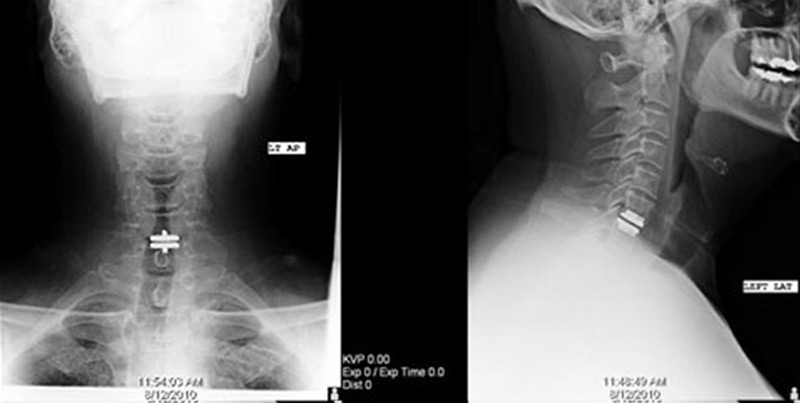
Photo: spine.org
When is Disc Surgery Needed?
Before getting into the details of surgery, at that place are iii general indications for disc surgery in the cervix: spinal cord compression, compression of a nervus root coming off the spinal cord past the disc, and painful disc disease.
Spinal Cord Compression. Out of the three indications, spinal cord compression is the strongest. This causes a condition known as myelopathy which describes a situation where compression of the spinal cord results in harm to the inside of the cord. The symptoms of this can be subtle and pain may oftentimes only exist balmy. The biggest thing people find is loss of balance and loss of hand coordination. Sometimes I detect out people are myelopathic when they take had a fall that a normal person should not have. What is confusing is that people often remember they are just getting sometime and clumsy. The reason that myelopathy is and so of import to catch early is that these changes are irreversible. Once someone starts to develop symptoms of myelopathy and spinal string compression is demonstrated, there is picayune role for non-operative treatment.
Spinal Nerve Root Compression. Spinal nervus root compression is different than spinal cord pinch. The chief symptoms of nervus root pinch is pain and others include weakness or numbness. Information technology is coordinating to sciatica. Unlike spinal cord pinch, the symptoms of nervus root compression can improve with time and are more commonly reversable with surgery. For this reason bourgeois care and time are usually given a risk earlier surgery is considered. When surgery is considered, the success charge per unit, particularly for relieving pain, is relatively loftier.
Cervix Pain with Degenerative Disc Affliction. The last reason to consider cervical disc surgery is neck pain with degenerative disc disease. Unfortunately surgery for this status is not every bit successful and sometimes leads to increased hurting. For this reason, conservative measures are exhausted before surgery is considered. Fortunately, this type of mechanical neck pain almost always responds well to conservative care.
The Standard Method: Inductive Cervical Discectomy & Fusion
In the case that cervical disc surgery is indicated, the historical "standard of care" has been to remove the disc from the front then "fuse" the os to a higher place and below the disc together. Fuse means to make two basic grow together into one bone so there is no longer move between the bones. The fusion technique has evolved from using a piece of bone from the hip area of the pelvis to using a plate and screws with donor bone. More than recently surgeons take started using "cages" that have integrated fixation to hold them into the bone above and below the disc that has been removed. In all of these techniques the actual therapeutic part of the surgery is to remove the disc and bone spurs that are pinching the spinal cord or nervus roots and this office of the surgery works well. Once the pressure is off the pain of pinching the nerve or the damage to the spinal cord is stopped. Unfortunately if you terminate at that place you have a hole in the forepart of the spine where the disc was which is what led surgeons to fuse these cases.
Every bit mentioned, the initial success rate of fusion is loftier. In the neck studies take shown greater than 90% of patients have meaning improvement in their symptoms following a i level cervical fusion.
There are two problems with fusions nevertheless.
Kickoff, there is a hazard information technology does not fuse. For a single level instance this chance is low but for multi-level cases it goes upwardly considerably. The other problem is more long term. Basically if you take away motion from one level by fusing it together, the level above and blare take upwards the strain and wearable out more quickly which may ultimately lead to the need for additional surgery.
An Alternative Method: Cervical Disc Replacement Surgery
Disc replacement surgery starts out like a fusion surgery. The disc is removed from the front end of the neck allowing decompression of the spinal cord and nervus roots. So, instead of putting a os graft or a muzzle between the bones and locking them together a disc replacement is placed. Like a knee replacement or a hip replacement the disc replacement moves. This allows the level which had the disc removed to move approximately like it would with a normal disc. In that location is no risk that the 2 basic do not fuse together and considering it moves at that place is not boosted strain placed on the disc above and below so they volition wear at a normal charge per unit and not an increased charge per unit.
What does this really hateful for disc replacements? Since the disc has been removed and the pressure is alleviated from the spinal string or nervus root this process has a similar initial success as the fusion. There is no need to expect for fusion so recovery is besides easier. Patients can start moving their neck right away and do not need to wearable a restrictive and uncomfortable collar. Finally and probably most importantly, the charge per unit of boosted surgery is significantly lower with disc replacements than with fusions and so long term patients are less likely to demand another performance on their neck.
What about replacing more than i disc at a time?
If yous retrieve about it all the problems associated with a fusion, specifically the failure to fuse and the increased strain on the other levels of the cervix, must get worse the more levels you fuse. It turns out this is true. The success rate of a two level fusion is not as good every bit that of a single level and three levels are even less successful. This is where disc replacement really shines. While studies suggest that single level disc replacements practise a piffling better than single level fusions, for 2 level surgeries the difference is significantly greater. Logic suggests that this will be the case for iii level disc replacement compared to fusion just this has not been well studied and is not currently FDA canonical.
In my experience I have seen a adequately significant divergence when I compare the outcomes of my disc replacement patients to those of my fusion patients. When the underlying status is the same I accept found that disc replacement patients recover faster and are less probable to return several years subsequently with new problems at other levels in their neck. In addition I have not seen any complications directly due to a failure of the disc replacement.
What are the risks of disc replacement?
Well, no surgery is perfect and the outcome can never be completely predicted. There are many potential risks but these are the most mutual ones. Disc replacement involves a surgical exposure of the forepart of the neck where in that location are a number of things that tin can be injured including the arteries that supply blood to the brain, the esophagus which carries food from the mouth to the stomach and the nerves that work the vocal cords. Inside the spine itself there is a risk of injuring the spinal cord or the nervus roots. In addition like whatsoever surgery at that place is a risk of bleeding or infection. The surgery is done under a general anesthesia and so you lot are totally asleep but there are also risks of general anesthesia including a bad reaction to the anesthesia and pneumonia. Fortunately the overall gamble is depression making this one of the most successful surgeries that I preform.
Who is a Candidate?
Lastly, every case is different and not everyone is a candidate for disc replacement surgery. Sometimes also much bone needs to be removed in order to adequately decompress the nerves and spinal cord making a fusion necessary. Other times the bone is not strong enough to support the disc replacement or there may be too much arthritis. And of course some insurance companies still do not pay for the process, calling it experimental even xiv years after information technology was FDA canonical.
To discover out more about disc replacement and to see if you are a candidate call for an appointment.
Source: https://huffmanclinic.com/cervical-disc-replacement-what-i-learned-after-15-years-hundreds-of-cases/
0 Response to "Two Years Ago I Had Surgery on My Neck Disc Replacement and Now I Have Pain Again"
Postar um comentário